

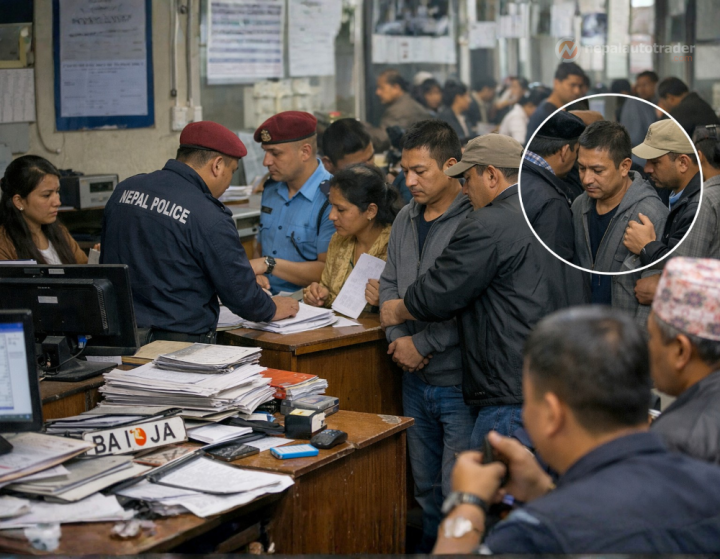
15 middlemen arrested at Transport Management Office Ekantakuna during enforcement action
Operation led by Nepal Police to curb illegal service practices
Middlemen charged extra fees for faster vehicle registration, license issuance, and ownership transfer
Crackdown aims to improve transparency and efficiency in Nepal’s automotive system
Direct impact on car buyers, dealerships, and EV adoption timelines
Reduces hidden costs in vehicle ownership and supports fair pricing
Signals possible reforms including digitization and process simplification
Nepal’s automotive market is growing fast. Electric vehicles are gaining traction. New models are entering the market. Buyers are more informed than ever.
Yet one persistent issue has slowed everything down. The transport office system.
The recent arrests at the Transport Management Office Ekantakuna highlight a deeper problem. Middlemen have been controlling access to essential services like vehicle registration and driving licenses. This has created delays, inflated costs, and reduced trust.
This crackdown is not just about law enforcement. It is about fixing a key bottleneck in Nepal’s automotive ecosystem.
Nepal is positioning itself as a strong EV market. Affordable EV options are expanding. Brands are competing on battery range, features, and pricing.
But the ownership journey has remained inconsistent.
Key challenges included
Delayed registration processes
Informal payments to speed up services
Dependency on agents for basic procedures
Lack of digital systems
These issues affect more than convenience. They directly impact EV adoption.
EV buyers often rely on government incentives and timely documentation. Any delay reduces the appeal of switching to electric.
| Process | Official Method | Reality Before Crackdown |
|---|---|---|
| Vehicle registration | Direct submission at office | Long delays without middlemen |
| Driving license issuance | Written and trial exams | Extended waiting periods |
| Ownership transfer | Document verification | Extra unofficial fees |
| Bluebook renewal | Annual renewal | Agent dependency common |
Artificial delays to encourage paid shortcuts
Lack of transparency in service timelines
Overcrowded physical systems with no digital backup
Weak enforcement until now
The crackdown changes the equation for everyone involved.
Lower total ownership cost
Faster vehicle delivery and registration
Reduced reliance on third parties
Better customer satisfaction
Faster handover timelines
More predictable operations
Easier access to incentives
Improved documentation flow
Stronger confidence in ownership process
This is critical in a market where buyers are already evaluating battery range, charging network availability, and long term savings.
| Factor | Nepal before crackdown | Nepal after crackdown | India benchmark |
|---|---|---|---|
| Registration speed | Slow | Improving | Fast with digital systems |
| Transparency | Low | Moderate to high | High |
| Middlemen dependency | High | Declining | Minimal |
| EV support ecosystem | Moderate | Improving | Strong |
Nepal is moving in the right direction. The gap with regional leaders is narrowing.
For automakers, this development is quietly significant.
Faster registration improves delivery cycles
Reduced hidden costs make pricing more competitive
Better ownership experience builds trust
This matters most in the affordable EV segment where buyers are cautious. They evaluate everything from charging infrastructure to resale value.
A smoother registration process removes one major friction point.
The arrest of 15 middlemen is a small headline with big implications.
If this action leads to consistent enforcement and system reform, Nepal’s automotive sector could become far more efficient.
The next steps are clear
Digitize transport services
Introduce online applications and tracking
Standardize fees and timelines
In a market focused on best selling EVs, battery range, and charging networks, the ownership experience is often overlooked.
This crackdown brings that issue into focus.
And that may prove just as important as any new vehicle launch.

Nepal Auto-Trader is one-stop platform for all automotive needs. We provide unbiased and unparalleled news/reviews of all auto-motives being launched in Nepalese Auto-Industry. Find recent updates and price of bikes/cars, compare and review recently launched bikes/cars, buy/sell/trade reconditioned cars/bikes and all government news about changing rules and regulation, road safety by subscribing us.

Subscribe to our Newsletter
© Copyright 2026, Nepal Autotrader



.png)
.png)