

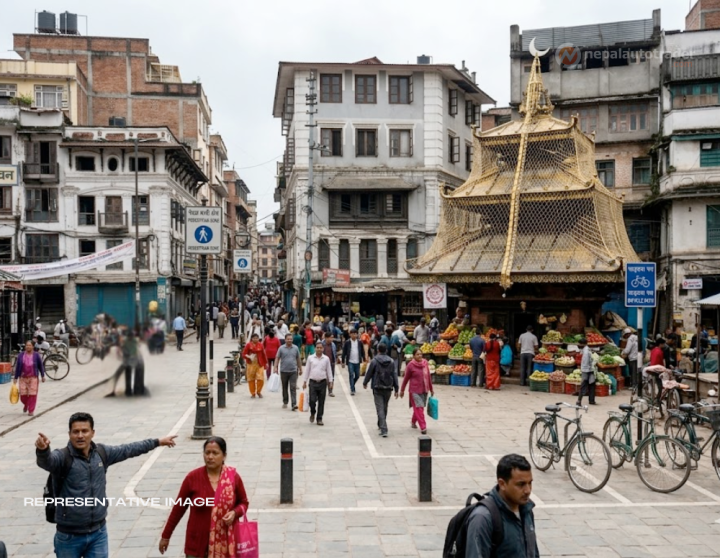
Asan Bazar, one of Kathmandu’s most historic and densely packed marketplaces, is now entering a new phase, one defined by fewer engines and more footsteps. Authorities have moved to declare the area a vehicle-free zone every Saturday starting Baisakh 2083, targeting congestion that has long choked its narrow streets.
The decision directly addresses the long-standing clash between traditional urban design and modern vehicular pressure. Asan was never built for cars. It shows. Tight lanes, heavy footfall, and constant movement have made traffic not just inconvenient, but unsafe. That matters.
The rollout of the vehicle-free zone is structured around controlled access rather than an outright ban across all hours. This allows essential movement while prioritizing pedestrians during peak times.
| Aspect | Details | Impact |
|---|---|---|
| Zone Coverage | Asan Bazar core area | Reduced congestion in dense streets |
| Vehicle Access | Restricted during key hours | Improved pedestrian flow |
| Primary Focus | Pedestrian movement | Enhanced safety and accessibility |
It is a controlled experiment in urban discipline. Not perfect, not final, but deliberate.
And crucially, it signals intent. Kathmandu is willing to rethink mobility inside its most sensitive zones.
The logic is straightforward. The reality, less so.
Traffic congestion in Asan has long reached unsustainable levels. Pedestrians compete with motorcycles, delivery vehicles, and informal transport systems, all within streets that were designed centuries ago. The result is chaos, often normalized.
Key pressure points included:
This intervention attempts to reset that imbalance. Less metal, more movement.
It sounds simple. It is not.
Any restriction in a commercial hub carries consequences. Asan Bazar is not just a market, it is an ecosystem. Traders, suppliers, and customers operate in a tightly interwoven rhythm.
The immediate shifts are clear:
For businesses, this is both disruption and opportunity. Increased walkability often translates to longer dwell times. More time, more transactions.
But adaptation takes time. Always does.
There is also a cultural layer. Asan is not just commercial space, it is heritage. A quieter, less congested environment could restore some of that lost character. This changes things.
The move aligns with broader discussions around urban mobility in Kathmandu Valley. Congestion, pollution, and unplanned growth have pushed policymakers toward alternative models.
Pedestrianization, once seen as impractical, is now part of the conversation.
Comparable shifts are already visible globally, where historic cores prioritize people over vehicles. Kathmandu appears to be taking its first real step in that direction.
The signal is clear. The city is experimenting. Carefully.
The implementation phase will define success. Enforcement, compliance, and public acceptance will shape outcomes more than policy itself.
| Phase | Status | Focus Area |
|---|---|---|
| Announcement | Completed | Policy declaration |
| Initial Implementation | Starting Baisakh 2083 | Vehicle restriction rollout |
| Monitoring | Expected | Traffic and pedestrian flow analysis |
There will be friction. There always is when habits are challenged.
But if managed well, this could become a blueprint for other high-density areas in Kathmandu. A template, not just a trial.
And that is where the story gets interesting.
Q: What does vehicle-free zone mean for Asan Bazar?
A: The designation restricts vehicle entry into the core area, every Saturdays, prioritizing pedestrian movement and safety within the market.
Q: Will all vehicles be permanently banned from Asan Bazar?
A: No, access is controlled rather than completely banned. Certain vehicles may still enter during designated hours or for essential purposes.
Q: How will businesses manage deliveries in the vehicle-free zone?
A: Businesses are expected to adjust logistics, likely shifting deliveries to off-peak hours when vehicle access is permitted.
Q: Why was Asan Bazar selected for this initiative?
A: Asan’s narrow streets and heavy foot traffic made it one of the most congested areas, creating safety risks and limiting pedestrian mobility.
Q: Does this indicate more vehicle-free zones in Kathmandu?
A: While not officially confirmed, this initiative could serve as a pilot for expanding pedestrian-first zones in other parts of the city.
Q: How does this impact daily commuters?
A: Commuters will need to adjust routes and may rely more on walking or peripheral transport options when accessing the area.

Nepal Auto-Trader is one-stop platform for all automotive needs. We provide unbiased and unparalleled news/reviews of all auto-motives being launched in Nepalese Auto-Industry. Find recent updates and price of bikes/cars, compare and review recently launched bikes/cars, buy/sell/trade reconditioned cars/bikes and all government news about changing rules and regulation, road safety by subscribing us.

Subscribe to our Newsletter
© Copyright 2026, Nepal Autotrader



.png)
.png)