

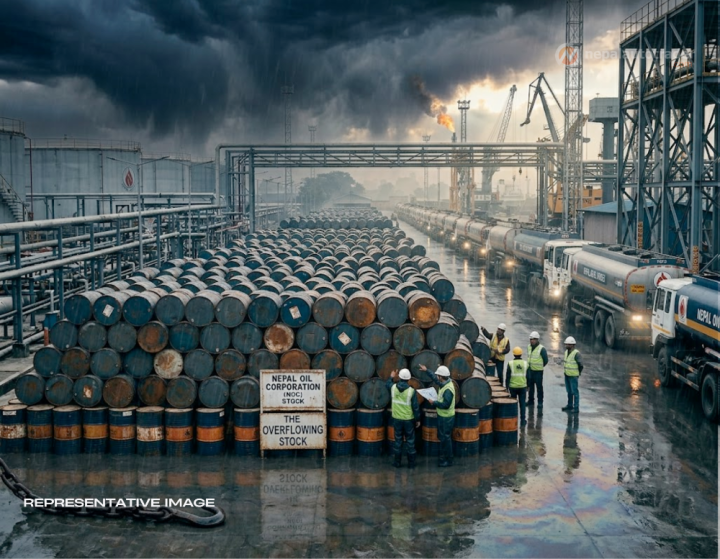
The price of crude oil has increased once again. It is not a surprise anymore, but it still lands hard. For a country like Nepal, fully dependent on imported fuel, every upward tick in global oil markets travels quickly through the system.
The latest rise reflects ongoing volatility in the international petroleum market. Supply concerns, geopolitical tensions, and demand recovery patterns continue to push prices upward. Nepal does not negotiate these prices, it absorbs them. That matters.
For Nepal Oil Corporation, this is not just a headline. It is a balance sheet problem. A structural one.
Each increase in crude oil cost tightens the margins for Nepal Oil Corporation. The state-owned entity already operates under a delicate pricing mechanism, adjusting domestic fuel prices based on international trends and supply agreements.
When global prices rise, the corporation faces two choices:
Neither is comfortable. Both have consequences.
Frequent price revisions have become the norm, not the exception. That creates uncertainty, not just for consumers, but for transport operators, logistics chains, and even small businesses that rely on fuel stability.
This is not just about oil. It is about economic predictability. This changes things.
Nepal imports fuel primarily through India, which itself bases pricing on international crude benchmarks. So when global crude moves, Nepal eventually follows.
Here is how the chain reaction typically unfolds:
| Stage | Trigger | Impact on Nepal |
|---|---|---|
| Global crude increase | Supply disruptions, demand spike | Higher import cost |
| Indian pricing adjustment | Refined fuel cost recalibration | Revised supply rates to Nepal |
| NOC pricing decision | Cost-pressure evaluation | Retail fuel price change |
It is a layered system. Slow at times, but inevitable.
And because Nepal lacks domestic refining or crude reserves, there is no buffer. No cushion.
Fuel price hikes do not always happen immediately after crude increases. Sometimes, Nepal Oil Corporation delays adjustments to manage public sentiment or absorb short-term fluctuations.
But sustained increases? Those cannot be ignored.
When prices eventually move, the impact spreads fast:
It starts with fuel pumps. It ends at grocery stores.
That is the real story here. Not the crude price itself, but what it triggers across the economy.
The repeated increase in crude oil prices is not an isolated event. It is part of a broader pattern. A volatile cycle driven by global uncertainties.
Energy markets are no longer stable, predictable systems. They react quickly to:
For Nepal, this means one thing, continued exposure. There is little insulation from these external shocks.
The country’s long-term energy strategy increasingly points toward alternatives, including electrification and renewable adoption. You can already see that shift in the growing EV ecosystem. For context, the Tata Punch EV and BYD Atto 3 represent that transition on the ground.
Still, fossil fuels dominate today. That reality has not changed. Not yet.
The immediate future depends on how long this global crude oil increase sustains. Short spikes can be managed. Prolonged upward trends force action.
Key indicators to watch:
| Indicator | What to Watch | Why It Matters |
|---|---|---|
| Global crude trend | Continued rise or correction | Determines import cost |
| Indian fuel pricing | Revision frequency | Direct supply pricing impact |
| NOC decisions | Retail price adjustments | Consumer-level effect |
If prices stabilize, Nepal gets breathing room. If they climb further, retail adjustments become inevitable.
And when that happens, it will not just be a fuel story. It will be an economic one.
That is where this is heading.
Q: Why are crude oil prices increasing again?
A: Crude oil prices are rising due to global market volatility, including supply constraints, geopolitical tensions, and shifting demand patterns. These factors directly influence international pricing benchmarks.
Q: How does this affect fuel prices in Nepal?
A: Nepal imports fuel, so higher global crude prices increase import costs. This often leads to higher petrol and diesel prices after adjustments by Nepal Oil Corporation.
Q: Will fuel prices increase immediately in Nepal?
A: Not always. Nepal Oil Corporation may delay adjustments temporarily, but sustained crude price increases usually result in eventual retail price hikes.
Q: Why is Nepal so affected by global oil prices?
A: Nepal does not produce oil and relies entirely on imports, mainly through India. This makes it highly sensitive to international price fluctuations.
Q: Are there alternatives to reduce dependency on fuel?
A: Yes, electric vehicles and renewable energy are emerging alternatives. Nepal is gradually adopting EVs to reduce reliance on imported fossil fuels.
Q: What should consumers expect next?
A: If global crude prices continue rising, consumers can expect increased fuel costs and a broader impact on transportation and goods pricing.
PREVIOUS NEWS

Nepal Auto-Trader is one-stop platform for all automotive needs. We provide unbiased and unparalleled news/reviews of all auto-motives being launched in Nepalese Auto-Industry. Find recent updates and price of bikes/cars, compare and review recently launched bikes/cars, buy/sell/trade reconditioned cars/bikes and all government news about changing rules and regulation, road safety by subscribing us.

Subscribe to our Newsletter
© Copyright 2026, Nepal Autotrader



.png)
.png)