

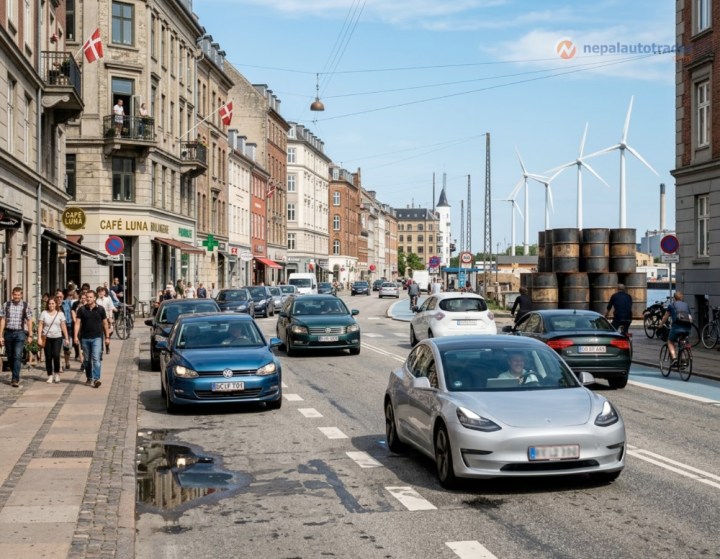
The war that erupted in Iran last month is not a distant headline for a handful of oil‑rich states. It reverberates through every fuel pump in Europe, a region still heavily dependent on imported petroleum. When crude breaches the $100 per barrel threshold, the knock‑on effect is immediate: wholesale fuel prices climb, taxes rise, and motorists feel the pinch at the pump.
That matters because Europe’s car fleet is still 67 billion euros‑heavy on petrol. The continent consumes that amount each year just to keep its internal‑combustion engines humming. A surge of this magnitude forces governments, fleets and everyday drivers to reconsider the economics of the car they own.
Lusian Matthew, director of the Clean Transport & Energy (T&E) car division, laid out the numbers in a freshly released briefing. He warned that when oil ticks past $100, the financial burden on a typical petrol‑car owner could be five times higher than that faced by an EV driver. The calculation is simple: fuel consumption stays constant, price per litre doubles, and the driver’s wallet takes the hit.
The statement is not hyperbole. In 2022 the Russia‑Ukraine conflict already pushed European fuel bills up by roughly 30 %. Add the current Middle‑East flare‑up, and the cumulative impact could eclipse 50 % for petrol owners, while EV charging costs remain relatively flat, anchored to electricity markets that have not seen comparable spikes.
“Oil may be a commodity that can be hoarded or redirected, but wind and sun are not,” Matthew said. “That is why EVs become the rational choice when oil prices break the $100 barrier.” This changes things for policy makers and car buyers alike.
Europe has long been a leader in electric‑vehicle adoption. Today more than 8 million EVs roam its streets, a number that dwarfs the continent’s EV share just five years ago. The latest T&E data shows a clear correlation between oil price spikes and EV registration spikes.
| Metric | Current | Previous Year |
|---|---|---|
| Annual petrol‑car spend (euros) | 67 billion | 62 billion |
| EVs on European roads | 8 million | 6.4 million |
| Average fuel price per litre (USD) | 1.95 | 1.45 |
| Average electricity price per kWh (USD) | 0.22 | 0.21 |
The table makes the gap obvious. While fuel prices climb, electricity remains a stable, cheaper energy source for mobility. That stability fuels consumer confidence in EVs, prompting a surge in bookings at dealerships across Germany, France and the UK.
The EU had set an ambitious target to ban the sale of new internal‑combustion vehicles by 2035. The goal was to cut transport‑related emissions by nearly a third and accelerate the shift to zero‑emission mobility. However, the latest report notes that several major manufacturers have lobbied for a softer timeline, citing supply‑chain constraints and the current oil market volatility.
The result is a delay in legislative momentum. While the ban is still on the books, enforcement mechanisms are being re‑examined, and some member states have hinted at a grace period extending to 2037. That matters because a slower phase‑out keeps petrol‑car sales alive longer, extending the financial strain on consumers during high‑oil periods.
Analysts agree that the current oil shock is a catalyst, not a permanent roadblock. Once crude prices settle—whether through diplomatic resolution or market correction—Europe is likely to double down on EV incentives, charging‑infrastructure roll‑outs and stricter emissions standards.
In the meantime, drivers can mitigate costs by:
The broader narrative is clear: petrol cars are becoming financially untenable when oil breaches $100, while EVs offer a predictable, lower‑cost alternative. The next few months will reveal whether policy will finally catch up with market reality, or whether the oil market will keep dictating the pace of Europe’s green transition.
Q: How much more could a petrol‑car owner pay compared with an EV driver when oil hits $100 per barrel? A: According to the T&E report, the cost differential can reach five times higher for petrol owners, driven by soaring fuel prices while electricity rates stay stable.
Q: When is the EU’s 2035 internal‑combustion ban expected to take effect? A: The ban is still scheduled for 2035, but recent industry lobbying may push enforcement to 2037 in some member states.
Q: How many electric vehicles are currently on European roads? A: Roughly 8 million EVs are in operation across Europe, a figure that has risen sharply over the past five years.
Q: Will the current oil price surge affect EV charging costs? A: No. Electricity prices have remained relatively flat, so EV owners are insulated from the crude‑price volatility that hits petrol drivers.
Q: What steps can drivers take to reduce fuel expenses now? A: Consider hybrid models, use fuel‑price‑alert apps, and evaluate home‑charging options that lock in lower electricity rates.

Nepal Auto-Trader is one-stop platform for all automotive needs. We provide unbiased and unparalleled news/reviews of all auto-motives being launched in Nepalese Auto-Industry. Find recent updates and price of bikes/cars, compare and review recently launched bikes/cars, buy/sell/trade reconditioned cars/bikes and all government news about changing rules and regulation, road safety by subscribing us.

Subscribe to our Newsletter
© Copyright 2026, Nepal Autotrader



.png)
.png)