

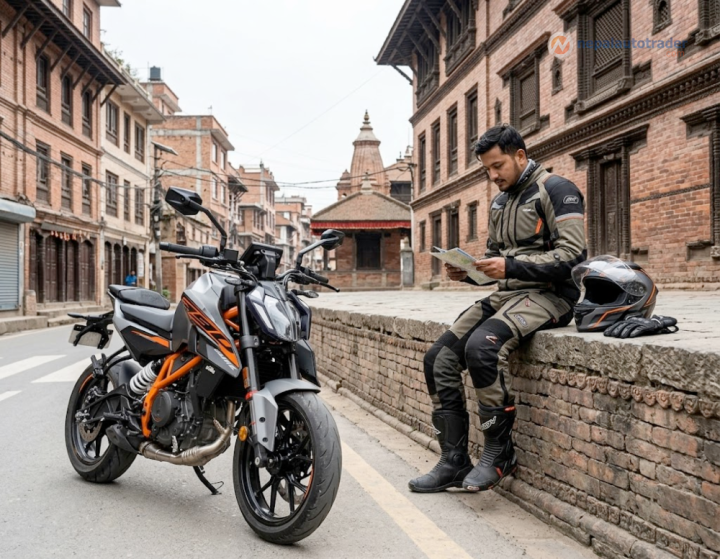
The KTM 390 Duke has never been a quiet presence in Nepal’s performance motorcycle space. Sharp design, aggressive pricing strategy, and a loyal following, it has always punched above its weight. Now, it gets more expensive. Again.
KTM India has officially revised the price of its 390 lineup with INR 40,000 increase. No mechanical updates, no feature expansion, just a straight adjustment. That matters. It tells you this is not about product evolution, it is about market pressure.
Price revisions like this rarely happen in isolation. Import duties, currency fluctuations, logistics costs, they all stack up. And eventually, the consumer absorbs it. This changes things.
Here’s the key detail, nothing under the skin has changed. The KTM 390 Duke continues with the same aggressive mechanical package that built its reputation.
| Specification | Details |
|---|---|
| Engine | 373cc, single-cylinder, liquid-cooled |
| Power Output | Not revised |
| Torque | Not revised |
| Transmission | 6-speed gearbox |
| Platform | Lightweight trellis frame |
That familiar punch remains. The quick throttle response, the lightweight feel, the razor-sharp handling, all intact. Buyers are paying more, but they are not getting more. That is the headline.
And yet, the appeal holds. Because in this segment, the KTM 390 still delivers an experience that few rivals match at this price band. That balance, it still works.
Price hikes in Nepal’s automotive sector rarely come with a single explanation. It is a layered story.
Each factor chips in. Together, they move the needle.
For KTM Nepal, holding the brand’s performance image matters as much as maintaining margins. Cutting corners is not an option. Raising prices becomes the cleaner move. That tells you where priorities lie.
The timing is interesting. The performance motorcycle segment in Nepal is no longer a one-horse race.
Rivals are circling, and some are closing in fast. Models like the Yamaha MT-15 and emerging mid-capacity offerings are giving buyers alternatives that were not as compelling a few years ago.
Even within KTM’s own ecosystem, the positioning gets tighter. Buyers start asking questions.
That decision becomes harder now. And that is exactly where competition thrives.
There is a shift happening. Not dramatic, but noticeable.
Performance bike buyers in Nepal are passionate, but they are also pragmatic. A price hike forces recalibration. Some will wait. Some will compromise. Some will move on.
Still, the KTM 390 carries strong brand equity. It is not just a motorcycle, it is an entry ticket into serious performance riding. That emotional pull, it does not fade overnight.
But repeated price adjustments test loyalty. Slowly. Quietly. That matters.
The immediate impact is clear, higher entry cost for one of Nepal’s most desirable performance bikes. The long-term effect is more nuanced.
If competitors hold pricing steady, KTM Nepal could feel pressure. If the entire segment shifts upward, this becomes the new normal.
Keep an eye on:
Because pricing is never just about numbers. It is about perception, timing, and trust.
And right now, the market is watching closely. Very closely.
Q: Which model has received the price hike in Nepal?
A: The revision applies to the KTM 390 Duke and its related lineup in Nepal. The update focuses on pricing, not specifications.
Q: Has KTM added new features with this price increase?
A: No, there are no confirmed feature or specification updates. The motorcycle continues with the same mechanical setup.
Q: Why did KTM increase the price of the 390 range?
A: The hike is likely influenced by import costs, logistics challenges, and broader market conditions rather than product upgrades.
Q: Are there alternatives to the KTM 390 in Nepal?
A: Yes, models like the Yamaha MT-15 and other mid-capacity motorcycles offer alternatives, though with different performance profiles.
Q: Will KTM reduce prices in the future?
A: Price reductions depend on market stability, policy changes, and cost structures. There is no official indication of a rollback.

Nepal Auto-Trader is one-stop platform for all automotive needs. We provide unbiased and unparalleled news/reviews of all auto-motives being launched in Nepalese Auto-Industry. Find recent updates and price of bikes/cars, compare and review recently launched bikes/cars, buy/sell/trade reconditioned cars/bikes and all government news about changing rules and regulation, road safety by subscribing us.

Subscribe to our Newsletter
© Copyright 2026, Nepal Autotrader



.png)
.png)