

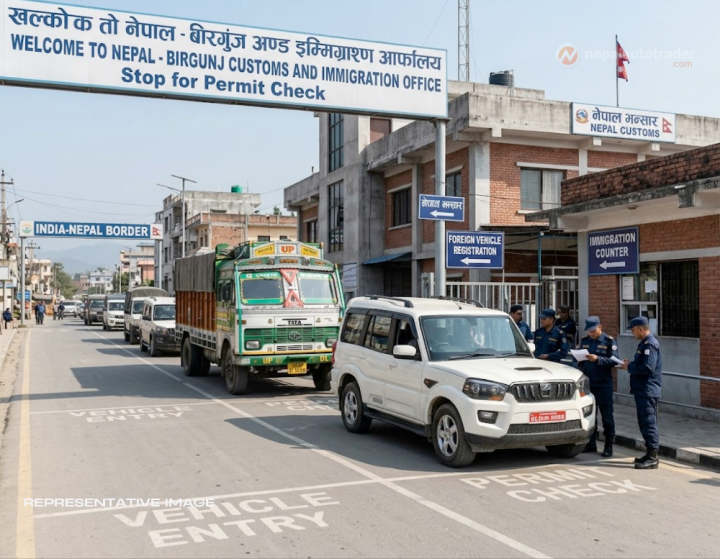
The conversation is getting louder. Stakeholders across Nepal’s transport ecosystem are now openly demanding tighter control over the day pass system for Indian vehicles. What was once seen as a facilitative mechanism for cross-border movement is now under scrutiny, and not without reason.
At the core sits a simple concern, misuse. Vehicles entering Nepal under short-term permits are allegedly overstaying or operating beyond the intended scope. That matters. It shifts the conversation from convenience to compliance.
Transport operators argue that the current system lacks teeth. Monitoring is inconsistent. Enforcement, even more so. The result, a growing perception that the system is being exploited rather than respected.
This isn’t just administrative noise. It signals a deeper structural gap in how cross-border vehicle movement is regulated.
The day pass mechanism was designed for simplicity. Quick entry, limited stay, minimal friction. In theory, it works. In practice, cracks are showing.
Key concerns raised by stakeholders include:
Each of these points hits a nerve. Especially the last one. Local operators feel disadvantaged when foreign vehicles operate with fewer restrictions. This changes things.
There is also a growing call for digitisation. Manual tracking systems, stakeholders argue, are no longer sufficient in a high-volume cross-border environment.
While no final policy has been announced, discussions are clearly moving in one direction, stricter control. The focus is not on restricting entry outright, but on ensuring compliance.
Potential measures being discussed include:
| Policy Area | Current Situation | Expected Shift |
|---|---|---|
| Permit Monitoring | Manual tracking | Digital verification systems |
| Enforcement | Limited checks | Stricter roadside inspections |
| Penalty Framework | Weak deterrence | Higher fines and penalties |
| Data Integration | Fragmented systems | Centralised tracking database |
These are not radical changes. But they are necessary. Incremental tightening can often deliver more impact than sweeping reforms.
Authorities appear cautious. Cross-border movement is sensitive. Any abrupt move risks disrupting trade and tourism flows.
There is a balancing act here. Nepal depends on fluid cross-border movement, especially with India. Tourism, small-scale trade, and personal mobility all rely on it.
Tightening rules could introduce friction. That is inevitable. But stakeholders argue that the long-term benefits outweigh short-term inconvenience.
Key impact areas include:
Still, the risk remains. Over-regulation could discourage legitimate travel. That matters. Policy design will need precision, not just intent.
For context, similar regulatory tightening in other sectors has shown mixed results. Execution is everything.
The push is not coming from one corner. It is broad-based. Transport entrepreneurs, regulatory observers, and industry insiders are all aligning on one point, reform is overdue.
There is also a sense of urgency. Delayed action could deepen existing loopholes. Once a system becomes normalized in its inefficiencies, fixing it becomes harder.
Some voices are calling for a phased approach:
This layered strategy makes sense. Quick wins first. Structural fixes later.
The direction is clear. The timeline is not. Authorities are expected to continue consultations before formalising any changes to the day pass system.
What to watch:
| Stage | Status | Implication |
|---|---|---|
| Stakeholder Consultation | Ongoing | Policy shaping phase |
| Draft Framework | Not announced | Clarity on enforcement |
| Implementation | Pending | Real-world impact begins |
This is a story still unfolding. And it will matter, not just for regulators, but for every driver crossing that border.
Sometimes policy shifts are quiet. This one isn’t. The signals are getting stronger. The system is about to be tested.
Q: What is Nepal’s day pass system for Indian vehicles?
A: It is a temporary permit that allows Indian vehicles to enter Nepal for a limited period. The system is designed to facilitate short-term cross-border travel without complex procedures.
Q: Why is there a demand to tighten the rules?
A: Stakeholders have raised concerns about misuse, including overstaying and weak enforcement. These issues are leading to calls for stricter monitoring and penalties.
Q: Will Indian vehicles be restricted from entering Nepal?
A: No such restriction has been announced. The focus is on improving compliance and enforcement rather than limiting entry.
Q: How could this impact tourism?
A: Stricter rules may introduce minor friction initially, but improved regulation could enhance long-term stability and fairness in cross-border travel.
Q: What changes are expected in the system?
A: Possible updates include digital tracking, stricter enforcement, and stronger penalty frameworks, though no final policy has been confirmed yet.

Nepal Auto-Trader is one-stop platform for all automotive needs. We provide unbiased and unparalleled news/reviews of all auto-motives being launched in Nepalese Auto-Industry. Find recent updates and price of bikes/cars, compare and review recently launched bikes/cars, buy/sell/trade reconditioned cars/bikes and all government news about changing rules and regulation, road safety by subscribing us.

Subscribe to our Newsletter
© Copyright 2026, Nepal Autotrader



.png)
.png)