

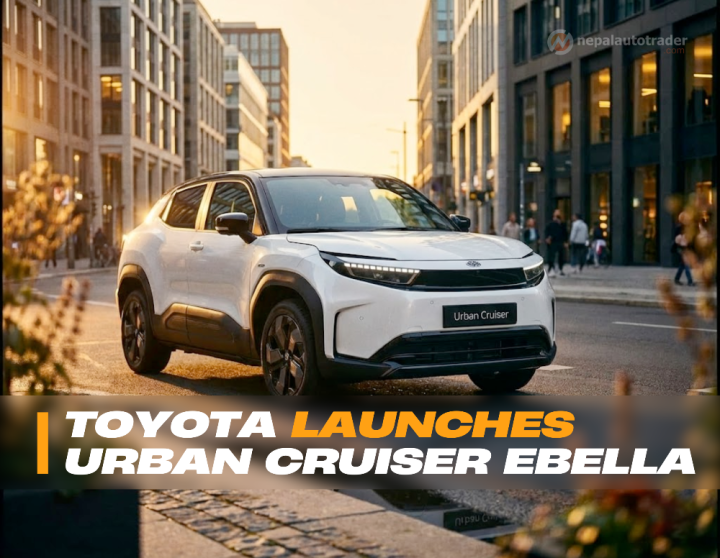
Toyota India has finally rolled out its first electric SUV for the Nepalese market, the Toyota Urban Cruiser Ebella. The model mirrors the design language of the Maruti Suzuki Celerio, with a sleek front end, segmented LED DRL and a triangular headlamp assembly. Thick black trim on the bumper and twin vertical air vents give it a rugged edge, while the rear door sports a clean C‑pillar handle. The silhouette feels familiar, yet the electric drivetrain marks a decisive shift for Toyota in South Asia.
The launch comes as the brand opens bookings on the same day. Dealerships in Kathmandu are already fielding enquiries, and the first deliveries are slated for early Q2 2026. That matters because the timing aligns with Nepal’s new incentives for zero‑emission vehicles, potentially accelerating adoption.
Toyota offers the Ebella in three trim levels – E‑One, E‑Two and E‑Three – each paired with one of two battery packs. The entry‑level E‑One carries a 49 kWh pack, while E‑Two and E‑Three receive the larger 61 kWh unit. According to the manufacturer, a full charge translates to 440 km of range for the smaller battery and 543 km for the larger one, based on the WLTP cycle.
Those figures sit comfortably above the 350 km threshold that many early‑stage EVs in the region struggle to meet. For a city like Kathmandu, where daily commutes average 30‑40 km, even the modest 49 kWh version offers ample buffer. The larger pack adds a safety margin for weekend trips to Pokhara or the Himalayan foothills – a selling point that could sway buyers who fear range anxiety.
Charging infrastructure is still nascent, but Toyota’s Battery as a Service (BaaS) model promises to mitigate that hurdle. Owners can swap depleted packs at designated stations, a concept borrowed from the European market. It’s a bold move that could reshape how Nepalese drivers think about EV ownership.
Step inside, and the Ebella feels more like a compact tech lounge than a traditional SUV. The dashboard is dominated by a 10.1‑inch digital driver display, while the central console houses a 10.25‑inch touchscreen that runs the latest infotainment suite. Wireless Apple CarPlay and Android Auto arrive as standard, meaning drivers can mirror their smartphones without a cable.
The cabin layout echoes the Suzuki Ertiga, with a floating centre console and a two‑spoke steering wheel that feels both sporty and ergonomic. Soft‑touch materials line the door panels, and the rear seats fold flat to expand the cargo bay – a practical touch for families.
Climate control is fully automatic, adjusting temperature based on cabin sensors. The system is linked to the vehicle’s telematics, so drivers can pre‑condition the interior via a mobile app before stepping out. That matters in Kathmandu’s winter chill and summer heat.
Safety is a headline feature on the Ebella. All variants come with seven airbags, ventilated disc brakes on all four wheels, and a suite of driver‑assist technologies that include Lane Keep Assist, a 360‑degree camera, front parking sensors, and an electronic parking brake with auto‑hold. The vehicle also offers adaptive cruise control and a rear‑view camera that pivots to show blind‑spot coverage.
Toyota has bundled these systems into a single package, avoiding the add‑on pricing seen on many rivals. The inclusion of a Battery as a Service plan means the battery is covered under a subscription, with periodic health checks performed at authorized service centers. This approach could lower the total cost of ownership, a critical factor for price‑sensitive Nepalese buyers.
The Ebella enters a crowded segment. Direct competition includes the Hyundai Creta Electric, which launched earlier this year with a 58 kWh pack and a claimed 470 km range, the Mahindra BE 6S offering a 60 kWh battery and 500 km range, and the newcomer VinFast VF 6S with a 62 kWh pack and 550 km range.
Toyota’s advantage lies in brand trust and the BaaS model. While Hyundai and Mahindra rely on conventional home‑charging, Toyota’s swap‑friendly system could attract fleet operators and urban commuters who lack private parking. That changes the competitive dynamics, pushing rivals to consider similar services.
Pricing has not been disclosed in exact numbers, but Toyota has hinted that the Ebella will sit in the “affordable premium” bracket, undercutting the Creta Electric’s price point while offering comparable range. If the market responds positively, we could see a rapid shift toward EVs in Nepal, especially as the government rolls out tax rebates for zero‑emission vehicles.
For a deeper dive into the Hyundai Creta Electric, see our recent Hyundai Creta EV review. To understand how Battery as a Service works, check the BaaS explainer. And for a broader view of Nepal’s EV landscape, read the electric SUV market overview.
Q: What are the exact price ranges for the Ebella variants? A: Toyota has not released precise pricing yet. The brand describes the entry‑level model as “affordable premium,” with higher trims expected to cost proportionally more.
Q: When will deliveries begin in Kathmandu? A: Bookings opened on 5 pm, Tuesday, Magh 6, 2082. Deliveries are scheduled for early Q2 2026, subject to final regulatory clearance.
Q: How does the Ebella’s range compare to the Hyundai Creta Electric? A: The Ebella’s 49 kWh version claims 440 km, while the 61 kWh version claims 543 km. Hyundai Creta Electric advertises a 470 km range from its 58 kWh pack, placing the Ebella’s larger battery slightly ahead.
Q: What does Battery as a Service include? A: BaaS provides a subscription‑based battery lease, regular health diagnostics, and access to swap stations where a depleted pack can be exchanged for a fully charged one within minutes.
Q: Are there any government incentives for buying the Ebella? A: Nepal’s current policy offers tax reductions and reduced registration fees for electric vehicles. Buyers of the Ebella will be eligible for these incentives once the vehicle is officially registered.
Q: Does the Ebella support fast charging? A: Yes. Both battery options are compatible with DC fast chargers up to 100 kW, allowing an 80 % charge in roughly 45 minutes for the larger pack.

Nepal Auto-Trader is one-stop platform for all automotive needs. We provide unbiased and unparalleled news/reviews of all auto-motives being launched in Nepalese Auto-Industry. Find recent updates and price of bikes/cars, compare and review recently launched bikes/cars, buy/sell/trade reconditioned cars/bikes and all government news about changing rules and regulation, road safety by subscribing us.

Subscribe to our Newsletter
© Copyright 2026, Nepal Autotrader



.png)
.png)